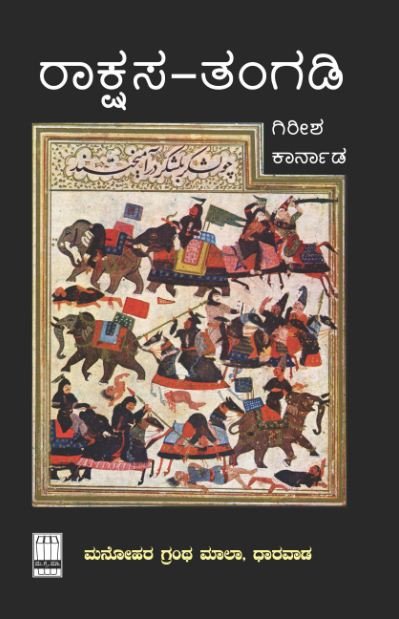
Raakshasa Tangadi by Girish Karnad is one of the most powerful and thought-provoking plays written by the legendary Kannada playwright Girish Karnad. Known for blending history with deep human drama, Karnad presents a gripping retelling of the historic Battle of Talikota (1565), which marked the fall of the mighty Vijayanagara Empire. The Raakshasa Tangadi by Girish Karnad play stands as a brilliant example of how theatre can bring history alive while exploring timeless human emotions and political realities.
The title “Raakshasa Tangadi” refers to the famous battlefield of Talikota, a turning point in South Indian history. Karnad transforms this historical event into an intense dramatic narrative filled with political intrigue, ambition, betrayal, and moral dilemmas. Rather than presenting history as a simple chronicle of events, he explores the human stories behind the fall of an empire. This approach makes the play emotionally powerful and intellectually engaging.
At the heart of the play is the tragic downfall of the Vijayanagara Empire, once a symbol of prosperity, culture, and strength in South India. Karnad paints a vivid picture of a kingdom standing at the peak of glory yet unknowingly approaching its collapse. The narrative unfolds during the tense period leading up to the battle between the Vijayanagara rulers and the united Deccan Sultanates. Through this setting, the playwright explores how pride, political miscalculations, and internal divisions can weaken even the strongest civilizations.
One of the most striking aspects of Raakshasa Tangadi by Girish Karnad is Karnad’s portrayal of historical characters as complex human beings rather than distant figures. Kings, generals, ministers, and soldiers are shown grappling with personal fears, loyalties, and ambitions. The play examines how individual decisions shape the fate of entire nations. This humanization of historical figures allows readers and audiences to connect deeply with the story.
Themes of loyalty and betrayal run strongly throughout the play. Karnad explores how alliances can shift under pressure and how trust can break at critical moments. Political ambition, ego, and rivalry become central forces driving the narrative forward. The play subtly asks whether the downfall of great empires is caused by external enemies or internal weaknesses.
Karnad’s writing style is rich, poetic, and dramatic. His dialogues are sharp and layered with meaning, making the play intellectually stimulating while remaining emotionally accessible. The language captures both the grandeur of royal courts and the tension of the battlefield. His ability to balance historical detail with theatrical intensity makes Raakshasa Tangadi a memorable reading and performance experience.
Another significant theme in the Raakshasa Tangadi by Girish Karnad play is the idea of destiny and fate. The characters often struggle with questions about whether history is shaped by human choices or inevitable destiny. This philosophical layer adds depth to the story and makes the play relevant even today. The fall of Vijayanagara becomes not just a historical event but a metaphor for the fragility of power and the cyclical nature of history.
The Raakshasa Tangadi by Girish Karnad play also highlights the cultural and emotional impact of war. Beyond politics and power struggles, Karnad shows the human cost of conflict. Families, soldiers, and ordinary citizens are all affected by decisions made in royal courts. This perspective makes the play emotionally moving and reminds readers that history is not just about rulers but about people.
Raakshasa Tangadi holds a special place in Kannada literature and Indian theatre as Karnad’s final play. It represents the culmination of his lifelong exploration of history, mythology, and human psychology. The play showcases his mastery in weaving research, storytelling, and theatrical craft into a powerful narrative.
For students of theatre, lovers of history, and readers of Kannada literature, this play is an essential read. It offers insight into one of the most significant moments in South Indian history while delivering a deeply engaging dramatic experience. Karnad’s ability to make the past speak to the present is what makes this work timeless.
In conclusion, Raakshasa Tangadi is not just a historical drama but a profound exploration of power, pride, and human vulnerability. Through masterful storytelling and deep philosophical themes, Girish Karnad creates a play that continues to resonate with readers and audiences. It stands as a fitting and powerful finale to the legacy of one of India’s greatest playwrights







Reviews
There are no reviews yet.